Top Signs You Need Garage Door Service – Don’t Ignore These
The clearest signs you need garage door service are a door that’s slower or louder than it used to be, a visibly stressed or gapped torsion spring, frayed or rusted lift cables, jerky movement, and an opener that strains or clicks instead of running smooth. None of these appear overnight. Each one is the door telling you which component is wearing out. If you’d rather not play detective, call (866) 947-9649. Otherwise, here’s how to read what your door is saying.
A garage door that takes two seconds longer to open than it did last year isn’t just “getting old.” It’s a door whose spring tension has dropped to the point where the opener motor is compensating, and that motor is now running at the edge of its rated load. That extra strain shows up as heat, noise, and eventually a dead opener or a snapped spring. The good news is that this story has warning chapters, and they’re easy to read if you know where to look.
The Speed and Smoothness Test: Reading Your Door’s Baseline
Your door has a normal. Your job is to know it. Once a season, stand back and watch a full open-and-close cycle. A healthy door starts, moves, and stops in the same rhythm every time, with a steady sound and no visible wobble. Aurora’s temperature swings between seasons give you two very different baselines to compare, and that’s useful. A door that runs smoothly in mild spring weather but drags when the temperature drops is telling you the spring system is losing the tension it needs to counterbalance the door’s weight.
Here’s what to track:
- Start time: Does the door hesitate a beat before it moves? That’s the opener picking up slack the springs used to handle.
- Travel speed: It should feel even from the floor to the header. A door that starts slow and speeds up, or slows near the top, is fighting imbalance.
- Stop quality: A firm, repeatable stop at both ends is healthy. A soft or bouncy stop points to travel-limit or spring issues.
- Smoothness: Watch the top edge. Any shimmy or side-to-side sway means rollers, hinges, or track alignment are drifting.
Write nothing down. Just notice. After a few weeks you’ll spot a change instantly, and that early catch is exactly when garage door repair is cheapest and simplest.
Visual Spring Inspection: What a Healthy Torsion Spring Looks Like
Torsion springs sit on a shaft above the door and do the actual lifting. They’re also the highest-risk component in the whole system, which is why you inspect with your eyes from the floor and never with your hands. A healthy spring is a continuous, evenly wound coil with clean gaps between the coils, no rust blooming on the wire, and a straight, unbroken profile. Signs it’s approaching failure include visible stress marks or hairline cracks, a gap where the coil has opened up, rust streaks along the wire, and a door that suddenly sits uneven or feels heavy to lift. Any of those mean it’s time to stop operating the door and have a specialist look. Springs store enormous tension, and a spring that lets go while you’re near it can cause serious injury. In our experience, homeowners who check their springs once a season catch problems before they become emergencies. For the mechanics behind this, see our page on garage door spring repair.
Cable Fraying Stages: From Surface Rust to Imminent Failure
Lift cables run along the sides of the door and are what actually connect the door to the spring system. They fail in stages, and each stage changes your urgency level. Stage one is surface rust or a few isolated wisps on the wire, which is cosmetic and worth monitoring. Stage two is visible fraying: broken strands in a localized spot and the cable starting to look fuzzy. That drops your timeline from “watch it” to “schedule service soon.” Stage three is a cable that’s visibly kinked, significantly reduced in diameter, or has a section unravelling, and that’s an immediate stop-use situation. A snapped cable can whip loose with real force, so don’t stand near a door with a questionable cable while it’s moving. When you’re spotting this in Aurora, a quick look at both cables from a safe distance is all it takes.
Opener Noise Taxonomy: Grinding vs. Straining vs. Clicking
Noise is the most honest diagnostic tool you have, because each sound points to a different component and a different repair timeline. Learn the three main categories and you’ll know what kind of problem you’re facing before anyone opens a toolbox.
- Grinding usually means worn gears or a dry or failing bearing inside the unit. On a LiftMaster, Chamberlain, Genie, or Craftsman opener, this is a mechanical wear issue that gets worse the longer it runs.
- Straining is the opener working harder than it should, and the usual culprit is spring tension loss or a misbalanced door rather than the opener itself. The motor is compensating, and it’s not designed to.
- Clicking often points to a failing logic board, a worn drive gear, or a limit switch that’s not registering. A door that clicks and doesn’t move is typically an electrical fault, not a mechanical one.
Brand matters here because diagnostics are brand-specific. A Genie and a Chamberlain fail in different ways, and the tolerances each manufacturer builds to tell you where to look first. That’s why we service the equipment you actually have rather than a generic substitute approach. When the noise turns into a dead door, garage door opener repair handles the full diagnosis. If the door simply won’t move and access or security is at stake, we run emergency service for exactly that situation. And yes, an opener that clicks three times and gives up is its own kind of passive-aggressive.
The Balance Test Every Aurora Homeowner Should Do Twice a Year
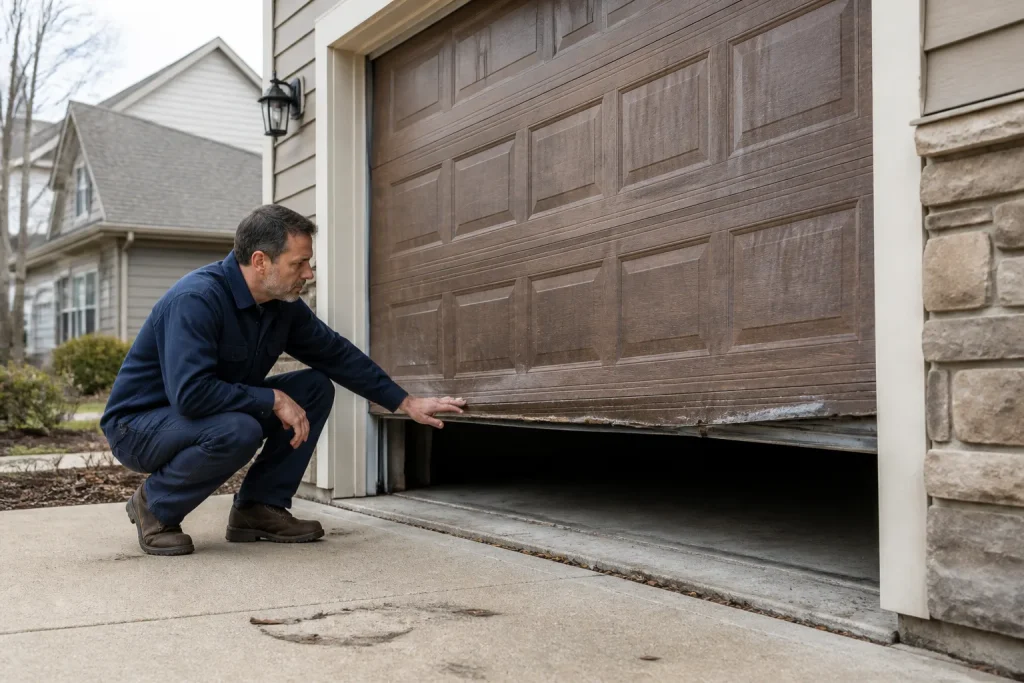
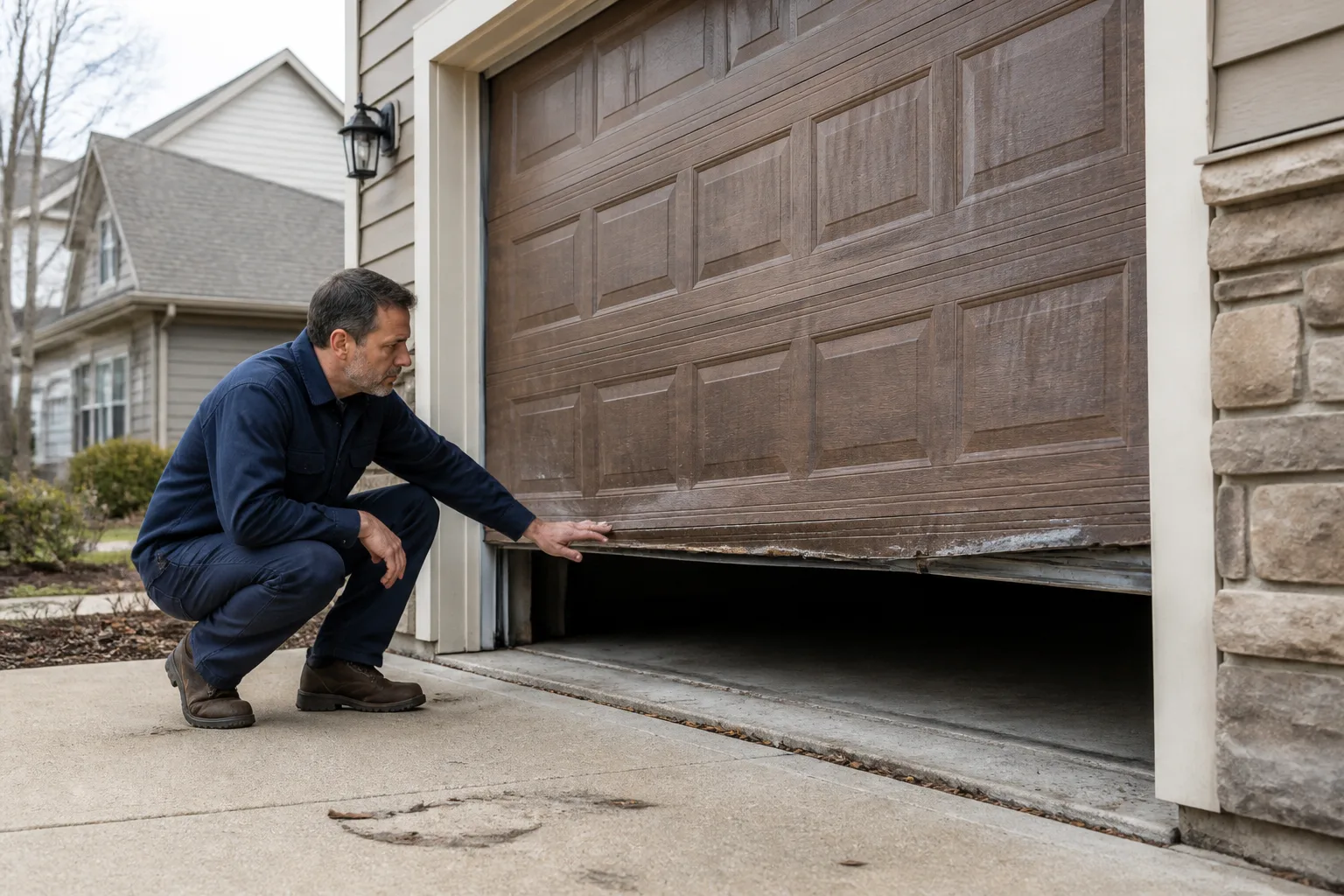
The balance test is the single most useful thing you can do to check spring system health, and it takes about a minute. With the door closed, pull the opener’s release cord so the door is in manual mode. Lift the door halfway by hand and let go. A properly balanced door holds its position, or drifts downward very slowly on its own. A door that slams down fast is one whose springs have lost most of their lift, and a door that flies up on its own is one that’s over-tensioned. If the door feels extremely heavy to lift, or if it drops hard, don’t do anything else to it. Stop and call a specialist. The springs are the fix, and they aren’t a DIY item. Do this test in spring and fall, when Aurora’s temperatures swing most, and you’ll catch a weakening spring while it’s still just a slow door rather than a snapped one. Full lifecycle coverage from repair through installation is what we do; you can read more about that company at Aurora Garage Door Repair Pros.
When to Call a Pro
Call a professional the moment you see a stressed or gapped spring, a cable in stage two or three, a door that drops hard in the balance test, or a door that won’t move at all. Those are the situations where a trained technician saves you time, money, and risk. Aurora homeowners can reach us for emergency service when the door won’t open or close and the house can’t wait. Everything else, like a noisy opener or a slow door, is worth scheduling before it becomes urgent. Springs, openers, panels, full installs: one call covers it all.
Related services in Aurora: garage door repair, opener repair, spring repair, and full installation from Amarr, Clopay, LiftMaster, and Genie, among other major brands.
The Bottom Line
Your door is far more communicative than it gets credit for. A slower cycle means dropping spring tension, a strained opener is telling you it’s carrying a load it wasn’t designed for, a rusty spring with a gap is a spring about to fail, a frayed cable has staged its own countdown, and each noise points to a different part. Do the speed-and-smoothness check, inspect your springs from the floor without touching them, and run the balance test twice a year. Our technicians have up to 9 years of experience and are factory-familiar with 8 major garage door brands, so the diagnosis lands on the right component the first time. If you’re in Aurora and need help, Aurora Garage Door Repair Pros offers free estimates and a written, agreed price before any work starts. Call (866) 947-9649.
Frequently Asked Questions
The most common signs are a door that’s slower or louder than it used to be, a strained or grinding opener, a visibly gapped or rusted torsion spring, frayed cables, and any jerky or uneven movement. Each points to a specific component, which is what makes a full inspection so useful.
Look for stress marks or hairline cracks, a gap in the coil, rust along the wire, and a door that sits uneven or drops fast in the balance test. If you see any of those, stop operating the door and call a specialist, since springs hold dangerous tension.
It can be. Grinding means worn gears or a bearing, straining usually means the opener is compensating for spring tension loss, and clicking often signals an electrical fault like a logic board or limit switch. Each has a different repair timeline, so an early diagnosis matters.
Twice a year is a solid routine, timed for spring and fall when Aurora’s temperature swings affect spring tension the most. Run the speed-and-smoothness check, inspect springs from the floor without touching them, and do the balance test so you catch a weakening spring early.
Call (866) 947-9649 for a free estimate.
Written by the team at Aurora Garage Door Repair Pros.
Need Garage Door Help?
Call Aurora Garage Door Repair Pros - the local pro we connect you with is licensed and insured, here with fast after-hours help in Aurora.
(866) 947-9649